
Unison · by Narek Maloyan
Free piano tuner app for iPhone and iPad
See the beat. Tune clean unisons.
Unison measures piano pitch and the beats between a note’s strings. Tune all 88 keys with measured stretch, a strobe display and pitch-raise tools. Every feature is free, with no ads, no account and offline audio analysis.
For the work between the strings
Piano technicians can use beat-rate guidance alongside their listening checks. DIY tuners get pitch, stretch and unison tools while learning the physical technique. Piano teachers can demonstrate beats and explain why several strings on one key need to agree.
Unison is a measuring tool for acoustic pianos. It does not turn tuning pins or replace a technician’s judgment. You still need a tuning lever, mutes and the skill to leave the tuning stable.
Piano-specific tools, all included
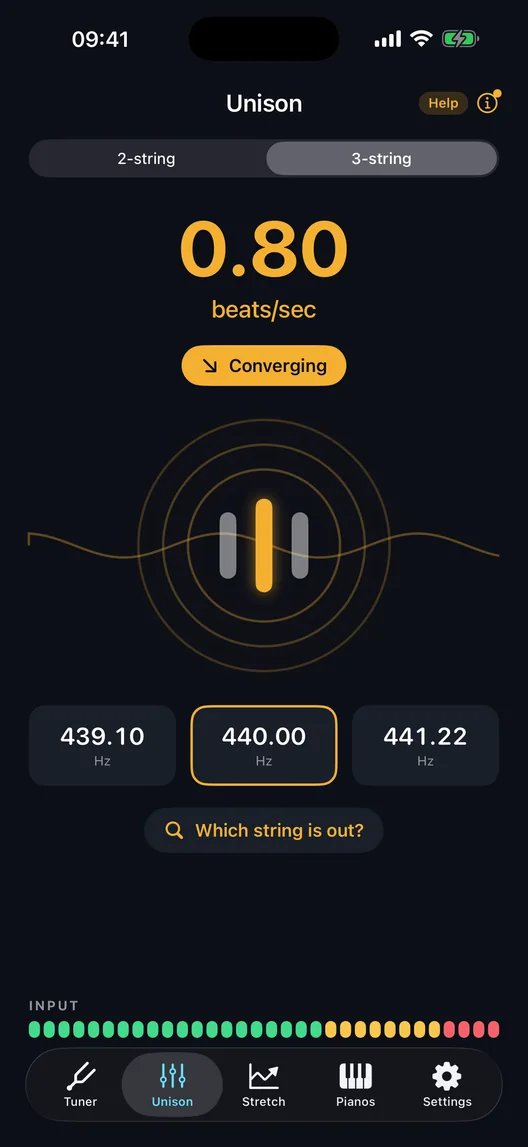
- Unison beat rate. See beats per second for two- or three-string notes, with Converging and Beat-free guidance. The “Which string is out?” flow compares muted string combinations.
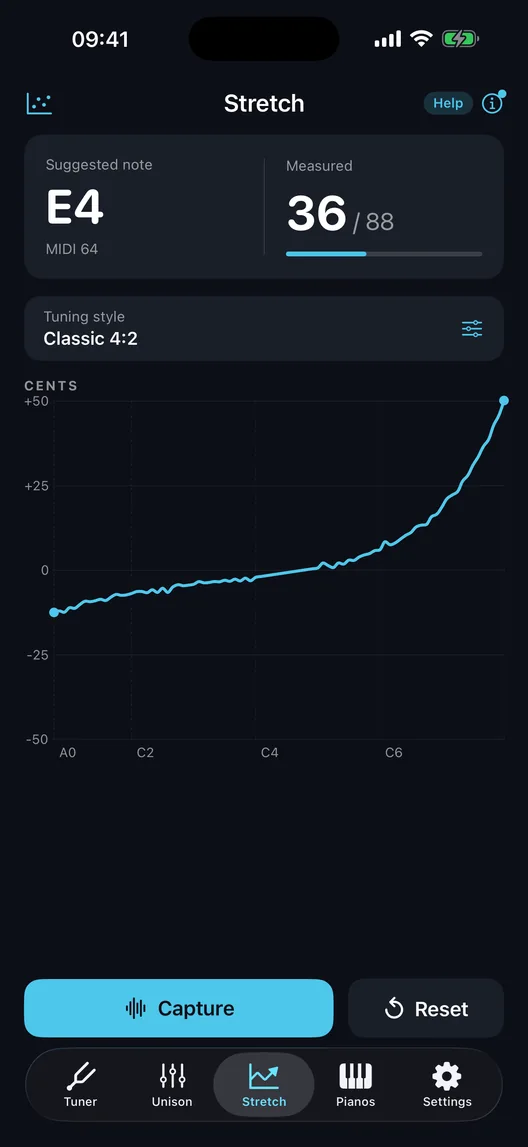
- Measured stretch and inharmonicity. Measure your piano’s partials to build its tuning curve, choose stretch styles, and adjust bass, treble or individual-note offsets. Understand stretch tuning.
- Temperaments and pitch reference. Choose equal temperament or seven historical temperaments, create custom temperaments, and set A4 from 415 to 466 Hz.
- Pitch raise. Pre-measure pitch offsets and apply calculated overpull, with section breaks and caps. Follow with a fine tuning and listening checks; a cap cannot establish whether an old string is safe to raise.
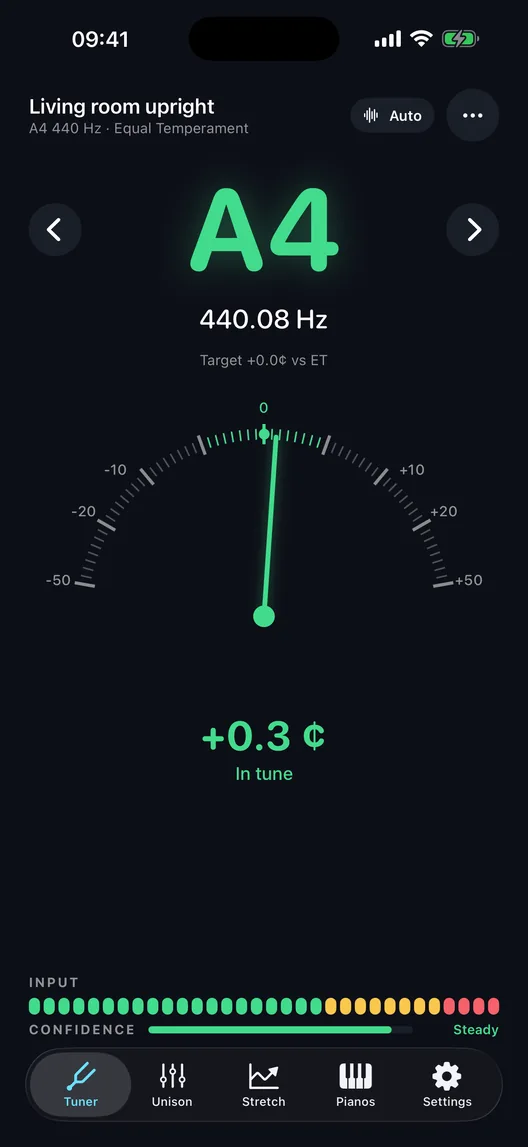
- Needle, strobe and spectrum. Read cents, follow a strobe, or inspect the spectrum. Select notes manually when automatic detection is uncertain.
- Offline and private. Audio analysis runs on the device. No ads, account, subscription or in-app purchase. See the privacy policy.
Unison, TuneLab, CyberTuner, pianoscope and PianoMeter
These are different tools and pricing models, not a laboratory accuracy ranking. Paid apps offer established professional workflows; Unison offers its piano-tuning tools without a paid tier. Check which features and file workflows suit your work.
| App | Price and access | Selected documented features |
|---|---|---|
| Unison | Free. All 88 keys; no in-app purchases. | Unison beat rate; measured stretch; eight built-in temperaments plus custom; pitch raise; needle, strobe and spectrum. |
| TuneLab | $299.99 on iOS. | Custom stretch from inharmonicity, phase and spectrum displays, multi-partial tuning and overpull. Spectrum peaks help with rough unisons. |
| CyberTuner | $999.99, including one year of CyberCare; then $84.99/year for Premium. Without it, Standard covers A3–A4 (13 notes). | Partial-matching stretch, spinner, pitch-raise modes and Aural Tutor. See features and subscription terms. |
| pianoscope | 14-day trial. Standard $99.99. Pro $699.99 once, $169.99/year or $17.99/month. | Standard includes measured stretch, strobe and instrument documents. Pro adds custom styles, spectrum and pitch raise. Edition comparison. |
| PianoMeter | Free evaluation tunes C3–C5. Plus about $30. Pro about $350 once or $60/year. | Measured stretch and automatic note detection. Plus adds full-range tuning and temperaments; Pro adds saved tunings, custom styles and pitch raise. Features and pricing. |
How to tune a piano unison with your iPhone
To tune a piano unison, set one string to the piano’s target pitch, then match the remaining strings to it. Use mutes to hear two strings at a time, reduce their beat rate, and recheck all strings together. Unison visualizes the beats; a tuning lever does the physical work.
Prepare the piano and phone
Use a suitable tuning lever and mutes. Place your iPhone near the strings, allow microphone access, and quiet nearby noise. If you have not learned safe tuning-pin technique, get hands-on instruction before making adjustments.
Set one string to the piano’s target
Choose the piano’s pitch reference and measured stretch in Unison. In the Tuner tab, mute the other strings of one note and tune the reference string to its target. Matching unison strings alone will not correct an off-pitch reference.
Listen to two strings together
Unmute one neighboring string and keep any third string muted. Open the Unison tab, select 2-string, strike the key and hold it. Read the beat rate in beats per second while listening to the pulsing sound.
Bring the second string toward the reference
Make small, controlled adjustments to the second string’s pin. Re-strike the note as needed. A falling beat rate and the Converging indicator help show progress; check by ear as the display approaches Beat-free.
Match the third string and recheck
For a three-string note, move the mute and repeat against the reference string. Remove the mutes, listen to all strings together, then strike the key again to check stability. Recheck the note’s overall pitch and nearby intervals before moving on.
A unison touch-up and a full piano tuning are different jobs. If the whole instrument is far below its intended pitch, assess the piano and its pitch-raise needs before polishing individual unisons.
Piano tuner questions, answered
Can an iPhone tune a piano?
Yes, an iPhone can measure piano pitch and guide tuning when you use a piano-specific app such as Unison. You still adjust the tuning pins with a tuning lever and isolate strings with mutes. The app supplies measurements; the person tuning supplies the mechanical skill and final listening checks.
How accurate is Unison?
Unison has tested pitch detection, but there is no guaranteed accuracy for every piano and room. Its README documents synthesized-signal tests and a benchmark using 446 recordings from three pianos. Microphone placement, noise, calibration and string behavior still matter, so check uncertain readings and listen to the finished tuning.
What is stretch tuning?
Stretch tuning places a piano’s bass slightly below and its treble slightly above a simple equal-temperament frequency table. Stiff strings have overtones that run sharp, so exact mathematical octaves can beat. Unison measures inharmonicity and uses it to calculate a stretch curve for the particular piano you are tuning.
What is a piano unison?
A piano unison is the group of two or three strings struck by one key and tuned to sound together. Small frequency differences produce audible pulses called beats. Unison displays that beat rate in beats per second, helping you bring the strings closer together while checking the result by ear.
How many cents off is too much for a piano unison?
There is no single cents threshold for every piano unison: the same cents difference produces faster beats at higher pitches. One cent above 440 Hz is about 440.254 Hz, a difference of 0.254 Hz. Aim for a calm, clean-sounding unison and stable pitch rather than a universal numeric cutoff.
Does Unison work offline?
Yes, Unison’s tuning tools work offline after you install the app. Microphone audio is analyzed on your iPhone or iPad, so tuning does not require Wi-Fi, mobile data or an account. Downloading the app and opening external support links need a connection; the pitch and beat measurements do not.
Is Unison really free?
Yes, Unison is free across all 88 keys and its tuning features. There are no in-app purchases, subscriptions, ads or account requirements. You can use the unison beat display, measured stretch tuning, temperaments, strobe and pitch-raise tools without unlocking a paid tier or starting a time-limited trial.
Do I need an external microphone?
No, you can use the microphone built into your iPhone or iPad. Allow microphone access so Unison can hear the piano, place the device near the strings, and reduce background noise. An external microphone is optional; a clear, sustained note matters more than simply buying extra equipment.
Can I use a guitar tuner to tune a piano?
A basic guitar tuner can check a reference pitch, but a piano needs more than a standard frequency table. Piano-specific tuning accounts for inharmonicity, stretch and multiple strings per note. Unison provides those tools, while your ears and tuning technique still determine whether the finished piano sounds balanced and stays stable.
Does Unison work on iPad or Android?
Unison is available for iPhone and iPad running iOS 16 or iPadOS 16 or later. The App Store listing includes both device types. There is no released Android version verified for this app, so use the linked Apple listing rather than assuming a similarly named Android app is the same product.
Can I tune my own piano without experience?
You can learn, but an app does not replace instruction in safe pin movement, string muting and tuning stability. Start by observing the pitch and beats, then learn the physical technique with suitable tools. For an unfamiliar, damaged or severely flat piano, have a qualified piano technician assess it first.
Bring the beat into view
Download Unison for iPhone or iPad, allow microphone access, and start by listening to a note. All tuning features are included.
Made by Narek Maloyan. Need help? Visit Unison support.